Fact check · Misleading
Bradford says families are "counting the minutes" waiting for 911. That wait was cut in half two years ago.
Across four posts in a week, the mayoral candidate built the case for hiring 1,000 police officers. The staffing figures underneath it are broadly right. Almost everything built on top of them — the 911 claim, the chart, and the characterisation of Olivia Chow's record — is not.
Families deserve to know they won't be counting the minutes after calling 911. Seniors deserve to feel safe taking transit. That's why I'm committing to hiring 1,000 new front-line police officers to strengthen neighbourhood policing, support officers who are being asked to do more, and help Toronto catch up with other major cities. The status quo isn't enough. Let's build a city we can be proud of: https://bradford26.ca/sign-up
Four days earlier, on Chow's record
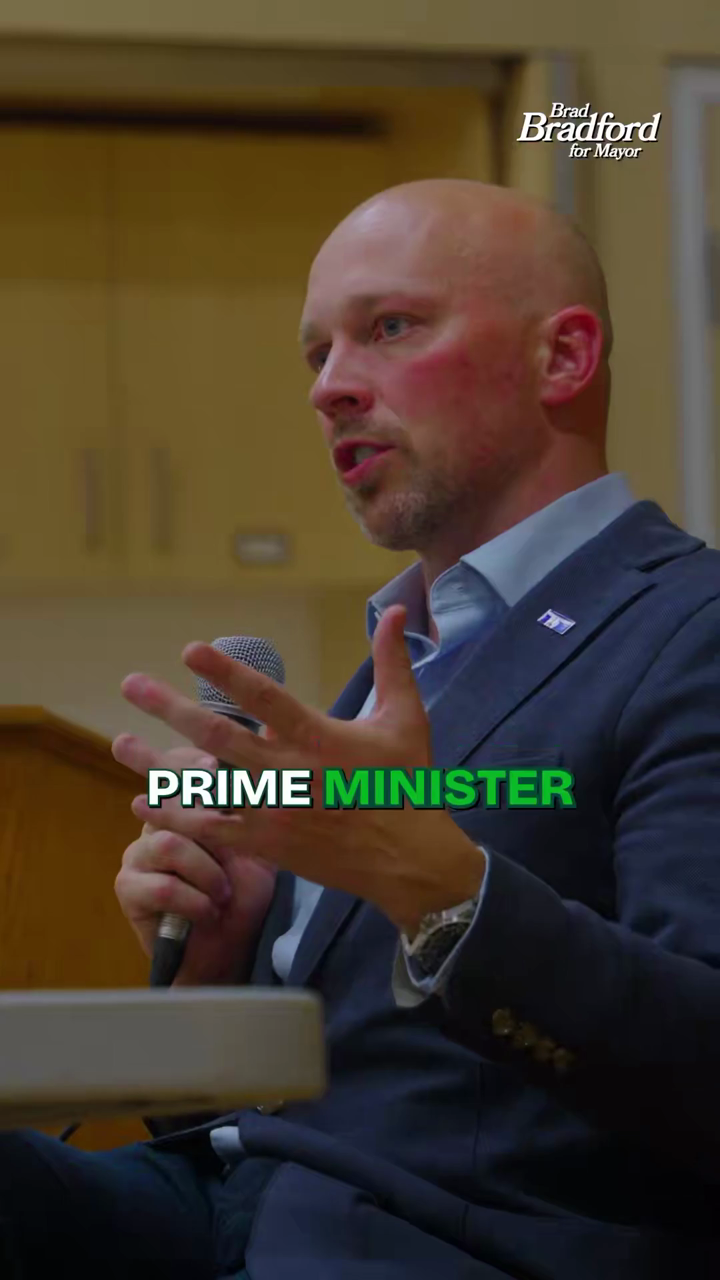
Every chance Mayor Chow has had to take action on public safety, she's decided not to. She's made her peace with the status quo. I haven't.
Transcript — from Whisper transcription of the clip's audio, condensed
I'll tell you a story. Prime Minister Carney was elected, and it's customary for the new Prime Minister to sit down with the Mayor of Toronto, because it's the largest city in the country, and they talk about shared priorities. Now, let's remember, the current PM was elected on bail reform, was elected on dealing with organized crime, was elected on auto theft. Two years later, we're having this meeting because we have those issues. [...] Mayor Chow penned a four-page letter to the Prime Minister outlining her priorities. In four pages, there was not a single sentence about bail reform, bail compliance, auto theft, organized crime, community safety.
The announcement itself, the day before the pledge post
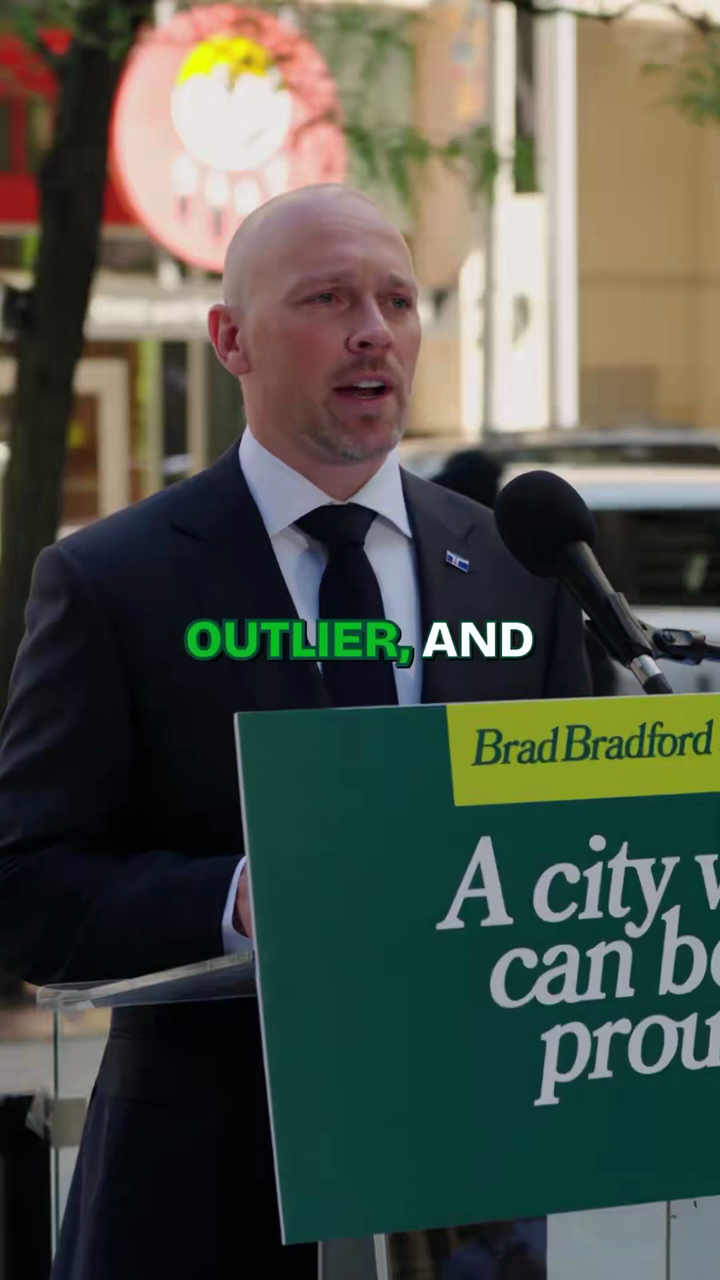
A safe city isn't built by asking people to do more with less. My plan will hire 1,000 more police officers to serve our communities and back up existing officers.
Transcript — from Whisper transcription of the clip's audio
What I'm proposing is not radical. This isn't an experiment. It's simply catching up to the country that we already live in. Toronto is an outlier and residents are paying for it. A thousand new officers will help ensure our police service has the resources it needs to keep our streets safe, our festivals, our transit, and our neighbourhoods safe. Because when a police service is stretched thin, the officers are stretched thin too. They're the ones working the double shifts, the relentless callbacks. They're the ones answering the calls alone that used to get two cars. They're the ones burning out and burning through their families to cover a staffing gap that they didn't create. It's more calls. It's longer nights. It's less backup. That's not a policing problem. That's a math problem. A thousand more officers means more backup arrives faster when you call for it. It means shifts that let officers go home to their families. It gives officers time to get to know the neighbourhood [...] walking it on foot instead of racing from call to call in a car. And it means that the best people stay here with the Toronto Police Service, because right now we train officers and then we lose them to forces that aren't running on empty. None of this is complicated. More officers on the street protecting more people in every neighbourhood. On October 26th, this city will have a choice.
Two days after the pledge, making the ratio argument directly
A big investment in Toronto's police is what this city needs.

Transcript — from the clip's burned-in captions, which reproduce his verbal stumbles, and corroborated against a Whisper transcription of the audio
And I— I think one of the things that we're grappling with right now is, even at the end of Mayor Chow's hiring plan, we're only gonna have three hundred more officers than we had in twenty-ten. And the city's population has grown by— by half a million plus since then. And that's why that ratio — it's, and you know, and I appreciate it's imperfect metric, the cop-to-pop, or number of frontline officers per 100,000 residents — you know, we lag behind other major, major jurisdictions here in the city. So it— it is a big investment, but it is one that is needed.
What he said
Between 20 and 26 July, Bradford ran the same argument across four posts: that Toronto’s police service is dangerously understaffed, that the current administration has done nothing about it, and that hiring 1,000 front-line officers is the fix.
The staffing numbers underneath the argument are broadly accurate. We checked them first, because a fact-check that gets that wrong has nothing to stand on. Then we checked what he built on top of them.
The staffing numbers hold up
Toronto does have the lowest officers-per-resident ratio of any large Canadian city — about 163 per 100,000 in 2023, rising toward 171 now. The population has grown by roughly 600,000 since 2010 while officer headcount stayed close to flat. On 26 July he put it precisely, and correctly: the hiring plan ends with “only three hundred more officers than we had in twenty-ten.”
He also, in that same clip, volunteers that cop-to-pop is “imperfect” — a caveat worth crediting, and one that appears in none of the other three posts.
The 911 claim is two years out of date
The pledge post opens: “Families deserve to know they won’t be counting the minutes after calling 911.”
That was a fair description of Toronto in 2023. Priority 1 response — the most urgent emergency calls — peaked at 26.7 minutes in October 2023. It is not a fair description of Toronto now. By early 2024 it was 19.6 minutes. On 4 March 2025 Chief Myron Demkiw reported it had fallen to 12.6 minutes, a seven-minute improvement in a single year, and it then held at or below roughly 13 minutes for four consecutive months.
A wait of 12.6 minutes is not nothing, and Toronto is not the fastest large city in North America. If the claim were simply “our response times should be better”, it would stand. But it is deployed as the reason a change of course is needed — “the status quo isn’t enough” — when the status quo is precisely what halved the number, and did so with the flat headcount he describes as the problem.
The ratio got worse. The service got better. Only the first half appears in the posts.
The chart is drawn to exaggerate
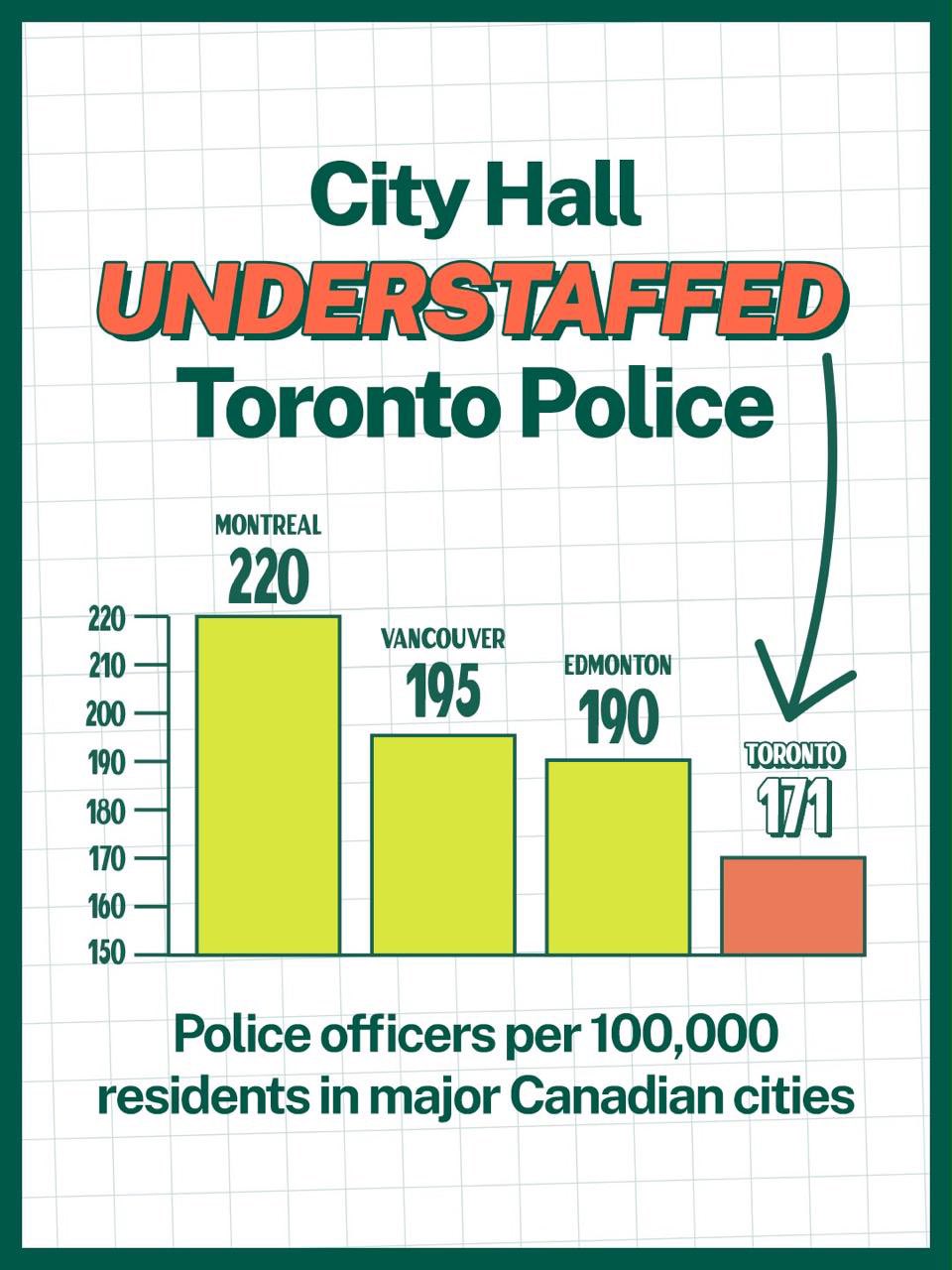
The pledge post carries a graphic headed “City Hall UNDERSTAFFED Toronto Police”, comparing officers per 100,000 across four Canadian cities.
The figures on it are defensible. The drawing is not: the vertical axis begins at 150, not at zero. Because every bar is missing its bottom 150 units, the differences between them are magnified roughly threefold.
| Montreal | Vancouver | Edmonton | Toronto | |
|---|---|---|---|---|
| Figure shown | 220 | 195 | 190 | 171 |
| Bar height as drawn, vs Montreal | 100% | 64% | 57% | 30% |
| True share of Montreal’s rate | 100% | 89% | 86% | 78% |
Toronto staffs at 78% of Montreal’s rate. The chart draws it at 30%. A reader glancing at the graphic sees a city with roughly a third of Montreal’s policing; the actual gap is 22%.
This is the one element of the campaign that cannot be explained as emphasis or omission. The numbers were chosen correctly and then rendered in a way that misstates their relationship.
“Every chance Mayor Chow has had… she’s decided not to”
Four days before the pledge, Bradford posted that “Every chance Mayor Chow has had to take action on public safety, she’s decided not to. She’s made her peace with the status quo.”
The record does not support this. Under Chow, the Toronto Police Service Board approved and the city funded a multi-year hiring plan running 360 officers a year through 2025 and 2026 — the same plan Bradford cites on 26 July when he notes where it lands by 2029. The 2026 police budget rose to about $1.43 billion, an increase of roughly $93.8 million, including $20.5 million for 143 net new officers. The 2025 budget added $46.2 million over 2024. Response times fell by more than half over the same period, and the Toronto Community Crisis Service was expanded citywide as a fourth emergency service.
Those are decisions to act on public safety, whatever one thinks of them. “Every chance… she’s decided not to” is not a characterisation of that record; it is a claim about it, and it is false. Taken on its own, that post would rate lower than this article’s verdict, and we expect to check it separately.
What actually fixed response times, and what it cost
Toronto did not close the response-time gap by hiring its way out. It closed it substantially by taking work away from police that police were never the right answer to.
The Toronto Community Crisis Service now functions as Toronto’s fourth emergency service. Between March 2022 and December 2024 it resolved 78% of the calls it took without any police involvement, with 2025 projections closer to 84%, on a budget in the range of two to three per cent of the police budget.
Set the two levers side by side, using the city’s own budget lines.
| Cost | What it delivers | |
|---|---|---|
| 143 net new officers (2026 budget) | $20.5M/year | ≈ $143,000 per officer, recurring |
| Toronto Community Crisis Service | ≈ 2–3% of the police budget | 78% of its calls closed with no officer dispatched |
Every crisis call TCCS absorbs is one an officer does not drive to, wait at, or write up. That is how a service with flat headcount halved its emergency response times. City staff have recommended expanding it further because the demand is there — so the cheapest capacity Toronto has bought in fifteen years is not yet exhausted.
Diversion has a real ceiling. It cannot absorb violent crime, it cannot run investigations, and eligible call volume eventually runs out. But nobody has shown Toronto is at that ceiling, and none of the four posts mentions diversion at all.
What the pledge would cost
Bradford has not costed it. His campaign said it would “roll those numbers out later in the campaign.”
The city’s budget supplies a floor. At the 2026 rate of $20.5 million for 143 net new officers — about $143,000 each, recurring — 1,000 officers runs on the order of $143 million a year, permanently. That is consistent with Councillor Shelley Carroll’s estimate that the pledge exceeds $100 million.
Chow has also noted that the police college caps training at roughly 360 officers a year, which is already what the current plan uses. The binding constraint on hiring faster may not be money at all.
And on Bradford’s own chosen metric: work backwards from service levels rather than peer rankings and the defensible range for Toronto is roughly 170 to 185 officers per 100,000. The existing plan reaches about 172 by 2029 — inside that range, at the bottom of it. Adding 1,000 officers would put Toronto near 200, above the range, at approximately Montreal’s rate in a city with well under Montreal’s crime.
That does not mean the file is closed. Holding 172 per 100,000 as the city grows requires continued net hiring simply to stay level, and the 12.6-minute figure came in a favourable season with crime falling; a full year will likely read higher. The honest reading is that the current trajectory is adequate and the proposed step-change is not supported by the service data.
The peer comparison doesn’t survive its own footnotes
The international comparisons are not like-for-like. The standard reference on this question — Matt Ashby’s benchmarking report for UCL’s Centre for Global City Policing — warns that “the responsibilities of police agencies vary substantially between cities.” London’s figure includes national counter-terrorism command, royalty and diplomatic protection, and national fraud policing. New York’s counts roughly 5,000 school safety agents and 4,000 traffic agents. Toronto shares rail, cyber, terrorism and border functions with federal and provincial agencies and counts none of them.
The Canadian comparisons invert once you divide by crime instead of population. Toronto’s crime rate is far below Montreal’s or Vancouver’s. Normalize by criminal incidents and Toronto fields roughly 55 officers per 1,000 Criminal Code incidents, against about 44 in Montreal and about 25 in Vancouver. The low cop-to-pop substantially reflects low crime, not a force stretched thinner than its peers.
One caveat cuts the other way: an understaffed force records less crime, because fewer officers are available to take reports and long waits discourage reporting. Some of Toronto’s low incident count is an artifact of its own staffing, so the per-incident advantage is an upper bound, not a precise figure.
The stronger argument he doesn’t evidence
The announcement video makes a different case from the other three posts, and a better one. It is about the officers rather than the ratio: people working double shifts and relentless callbacks, “answering the calls alone that used to get two cars,” burning out “to cover a staffing gap that they didn’t create.” It closes on retention — “we train officers and then we lose them to forces that aren’t running on empty.”
“That’s not a policing problem,” he says. “That’s a math problem.”
This is the strongest version of the argument for hiring, and it is largely untouched by everything above. Response times can recover while the people delivering them are being ground down; a service can hit its emergency targets on overtime and single-officer dispatch and still be running an unsustainable operation. Attrition is real — the hiring plan runs about 360 recruits a year to net roughly 143 officers, which implies a couple of hundred departures annually.
It is also the part of the campaign carrying the least evidence. No attrition breakdown showing officers leaving for other services rather than retiring. No figures on how often two-officer calls became one. No overtime totals. Those numbers exist, and a claim built on them could be checked. As posted, they are assertions — and they sit in the one video that does not get a chart, a statistic, or a peer-city comparison.
The ruling
Bradford’s staffing figures are accurate, and in one post he concedes the metric’s limits. That is the strongest thing that can be said for the campaign.
Everything assembled on top of those figures pushes the reader toward a conclusion the evidence contradicts. The 911 wait he invokes has been halved since 2023. The chart he published renders a 22% gap as a 70% one. The claim that Chow has declined every chance to act on public safety is contradicted by the hiring plan, the budgets, and the response-time record — including the very plan he cites elsewhere in the same week. And the cheapest lever Toronto has, the one that did much of the work, goes unmentioned across all four posts.
The distinction matters. This is not a set of false numbers. It is a set of true numbers arranged, and in one case drawn, so that they support a claim they do not support on inspection.
There is a real argument for hiring more officers, and Bradford gestures at it in the announcement video: workload, burnout, retention, single-officer dispatch. It is the one part of the week that the response-time recovery does not answer. He supplies no numbers for it, and builds the public case on a ratio instead.
Misleading.
Sources
- Post by @BradMBradford, 24 July 2026 (pledge and staffing chart)
- Post by @BradMBradford, 20 July 2026 (on Mayor Chow's record)
- Post by @BradMBradford, 26 July 2026 (NEWSTALK 1010 clip)
- Brad Bradford Pledges 1,000 New Police Officers
- Brad Bradford vows to hire 1,000 police officers over 4 years if elected
- Toronto mayoral hopeful pitches hiring 1,000 new police officers
- Remarks to the Toronto Police Service Board, Chief Myron Demkiw, 4 March 2025
- Toronto police responding to 911 calls 7 minutes faster than a year ago
- Response Times Decreasing
- BudgetTO 2026 Budget Notes — Toronto Police Service
- Toronto Police Service 2026 Budget Requests, Board Meeting 10 December 2025
- Toronto Police Service Board Approves 2026 Operational Budget
- Toronto City Council receives Toronto Community Crisis Service mid-year progress report
- Toronto should expand non-police crisis response service across city, staff recommend in new report
- Benchmarking police numbers in London against other global cities
- Police-reported crime statistics in Canada, 2023